NOTE: IN ORDER TO BETTER SEE PHOTOS IN THEIR FULL 1600 PX. RESOLUTION, VIEW THEM IN THE ALBUM FORMAT BY CLICKING ON THE LEAD PHOTO OR ANY PHOTO IN THE POST. This is especially true for landscape shots. Thanks to Mark for the idea of adding this alert so the photos can be seen at their best!
Showing posts with label plants. Show all posts

Tuesday, July 24, 2018

MUN Botanical Garden


One of the things I wanted to do on this trip was walk around the MUN Botanical Garden, so when Wayne came to get me in Mt. Pearl I convinced him to go. 

Wayne thinks these were Dogberry branches

How did I accomplish that?  Asking my second cousin Allison to meet us there made it hard for him to say no!
Me and Allison were wowed by the large hostas


I haven't seen Allison in at least 30 years, but thanks to Facebook it's easy to keep tabs on those distant relatives now!  Hanging out with her led to lots of interesting information on events coming up in the area like the George Street Festival which Wayne is definitely attending.

Green Frog - click here for info and to hear Green Frog call

I like things a little quieter than a festival.  I will probably drop him off and head for the East Coast Trail instead.  We've both decided that this trip is an opportunity to get out there and collect some new experiences.

More than 100 years ago, Queen Victoria chose the pitcher plant
to be engraved on a newly minted Newfoundland penny

The Botanical Garden had a small greenhouse, a vegetable garden, and various other flower beds but it also had a trail system that winds through its 110 acres.
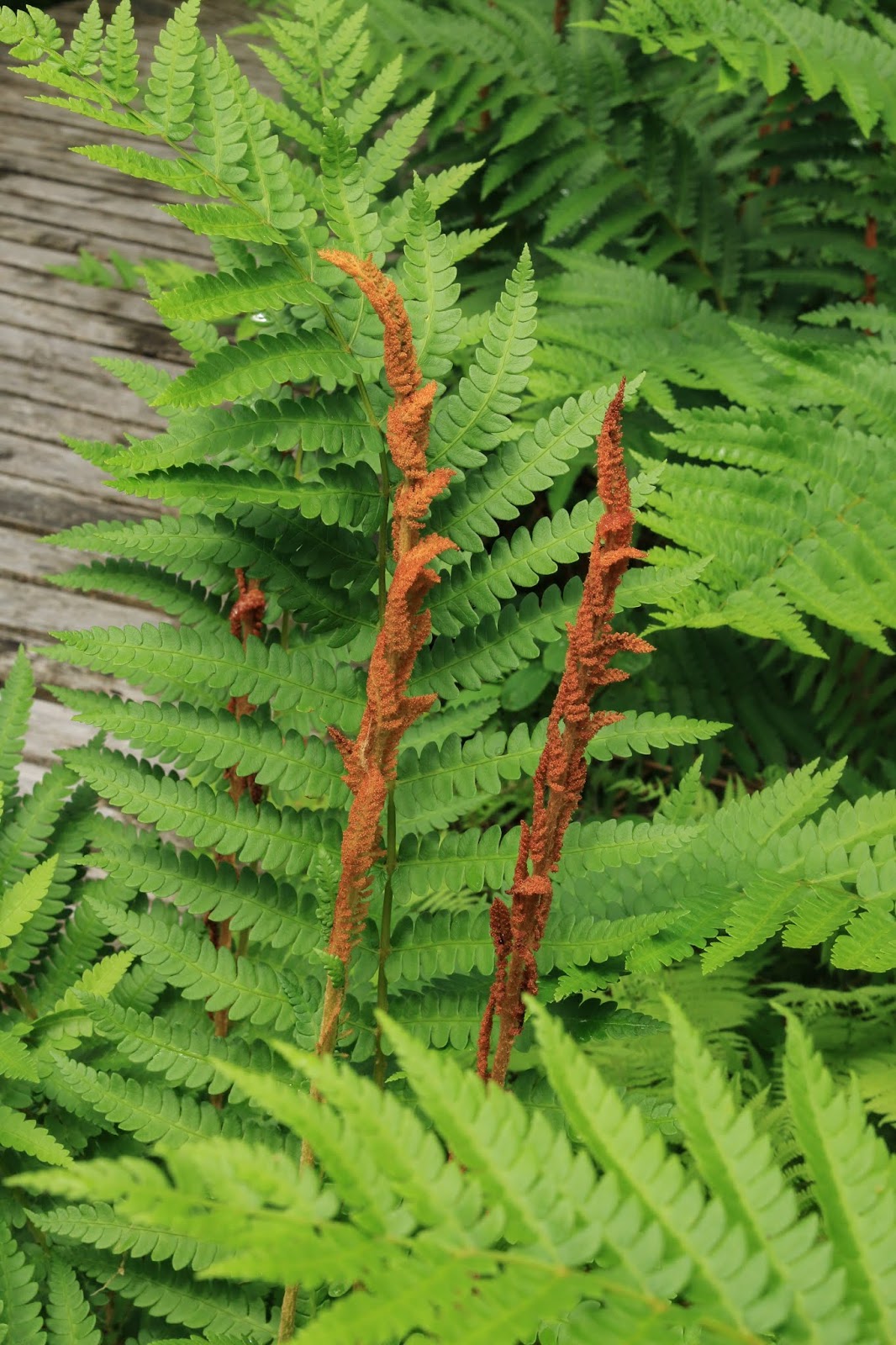
Cinnamon fern?

The Yetman Trail took us through the woods and across a fen to see some native plants but unfortunately most of those were not labeled like the ones in the flower beds were.

Foxglove

You don't have to go to the Botanical Garden if you want to see wild roses, they are everywhere in Newfoundland.


But if you want to see Gnome doors and houses, the garden is your best bet.


Also at the Garden is Oxen Pond where quite a few American Black Ducks were swimming around hoping for some handouts.


I'm guessing the Gnomes don't feed them, but who knows what goes on there at night?


With all these ladies swimming around there should be some youngsters around...

Male in the middle? ID info says pale brown head and yellow bill

Sure enough, they were all snuggled up on a rock having their afternoon nap.


There was a rather large loon on the pond as well, but he was a bit far off to get a good look.  So I settled for a picture of this instead.


A hosta with water droplets made for a good photography subject, but most of my flower shots the color was off so I'm guessing my settings were off.  Oh well, it's not always about the photos I bring home and this was a nice place to visit for $9 and we didn't even get bit by mosquitoes!


Tuesday, July 3, 2018

Daily Walk at Daley Ranch

When I first arrived in San Diego I spent too much time visiting and next thing you know I was driving to Dixon Lake Recreation Area and had to set up in the dark.  Luckily I was driving very slowly or I would have gone right off precipice when I turned into my site! It was a little unnerving, but after parking my car between the drop off and my tent I was able to relax and enjoy this view of Escondido from my precarious new home.


In the morning I was amazed to see what I had missed as I puttered up the winding road in the dark!


I stayed there 4 nights, and while I can't recommend the seriously scary bathrooms or showers (many thanks to my wonderful cousins for use of their magnificent facilities!), the campsites were fine at a reasonable $25 and the campground has access to Daley Ranch which is a hub for hikers, bikers and runners.  And of course the lake is accessible to those who wish to go fishing.


I didn't see a lot of wildlife on my trip to the desert, just a few lizards and lots of what I assume were Desert Cottontails.

Silly bunny, sitting still doesn't make you invisible!
 
Somehow I spied this caterpillar on one of the flowering plants!  Maybe my friends from Where the Wind Goes will chime in with an identification in the comment section.  


Since I get notified of their blog posts by email they are one of only two blogs I have kept up on in the last few months.  To everyone else my apologies but I will be catching up soon, I swear!  I've turned into a blog binger, kind of like Netflix but with reading!


Speaking of flowering things, there was a lot of  Yucca whipplei to enjoy, also know as Our Lord's Candle and Chaparral Yucca.


The spike grows 1-2 m tall from the base whose spiky blades up close reveal lovely colors.


The Diegueno and Cahuilla used the fibers for sandals while the Chumash and the Gabrielino used it for fishing line. Whole or split yucca leaves were also utilized for rough tying of bundles of firewood, house frames, and for basketry. 


After it is done flowering cluster of green fruit capsules are visible which the Antelope Ground Squirrel will eat.  Eventually it will split open and release the seeds, though the plant also can grow from offshoots.


From the seed the plant takes 5 or more years to reach maturity, flower and then die.  It is worth the wait...

Taller than I was!

Hundreds of flowers put on a stunning show before the plant ends its cycle, and not only do the bees and moths love them, but they are edible after boiling and supposed to be sweet tasting.  Sadly I did not get to taste them, just enjoy their subtle perfume while walking under the bright California sun!


Saturday, June 30, 2018

San Diego in Bloom

One of the most surprising things about my trip to San Diego was the variety of blooming plants.


I saw this blooming tree in Balboa Park, I think it's called Angel's Trumpet.  Now, I believe the astounding variety of blooms is due to plants being brought there from South American countries.  For example this shrub is originally from Ecuador and is a relative of Datura, something I grew in my own garden once for its large flowers.

Brugmansia

I got lucky and my visit coincided with the cacti blooming, but don't ask me to identify any of them because not a lot of cacti grow in the Midwest!  Maybe Prickly Pear?  It's a good place to start for a guess, feel free to laugh at me and correct me if I'm wrong!


The one below is an Indian Fig (or Barbary Fig) if I remember correctly.  It was growing outside the visitor center at Torrey Pines Recreation Area and had a sign.

Opuntia ficus-indica

Perhaps another Indian Fig Cactus? This one was located in Old Town State Historic Park and I caught a bird flying in for a look at the blooms.


At Mission San Diego de Alcala and a few other places I saw White Bird of Paradise which grows like a tree with a fan of large 5-foot-long leaves. It can grow to 30 feet tall and 15 feet wide!  I saw the standard orange Bird of Paradise plants in landscaping too, but didn't get any photographs.

Strelitzia nicolai

But the first blooms I saw were on the Jacaranda trees, straight out of the airport and everywhere I traveled. It loves full sun and sandy soil, and is native to Mexico and countries further south. The fragile blue hued blossoms were difficult to capture, so I settled for this shot.

Jacaranda mimosifolia

The twin flowers below were in a private garden.


And speaking of Datura, I believe this might be one of the species.  It was growing all over the rocks between the parking area and the beach at Torrey Pines.


Fences are good places to find unusual flowers.


And here's another tree I saw in Old Town.  The blossoms were so numerous that the tree was humming from all the bee activity.  Which did not stop families from sitting beneath it to get some shade in the heat of mid-day. A little identification help would be appreciated, Google didn't know what it was either!


Bougainvillea must be really easy to grow because like the Jacaranda it was everywhere!


Don't worry, I saved a few blooms aside for when I get to posting about my desert hiking.  I wanted to get to the San Diego Botanical Garden but ran out of time, which gives me something to do when I return again someday to visit my cousin and his hospitable family!

From left: Leacey, Cooper, Mom, Jack and cousin Chris

Thursday, November 19, 2015

Seeing Holly, Being Jolly - Old Sugarlands Trail

This trip to the Smokies has been an unbeatable mix of alone time and companionship.  Used to being on my own I enjoy hiking in solitude, but having someone to share discoveries with is a welcome change.


On Monday Sharon and I met to do a shuttle hike of the Old Sugarlands Trail.  The trail is wide for the Smokies and is relatively flat with just a short section of uphill to tackle where we started after parking at the Rainbow Falls parking area on Cherokee Orchard Road.


We smelled skunk and were glad it was not a live one on the trail!  The Old Sugarlands Trail was the original first paved road to Newfound Gap and before the road was paved it was a wagon road through the center of the Sugarlands Community.

possibly stone wall created when land was cleared for farming

We spied a lot of old foundations, stone property line fences and stone retaining walls and some of them warranted further exploration off-trail.  Sharon even spotted a few she hasn't noticed before.  I brought up the fact that every time I saw holly on the trail side during this visit it was just little knee-high stragglers and no sooner had we started discussing whether holly was actually indigenous to this area or not we started seeing American holly trees everywhere.

Many thanks to Sharon for patience with repeated posing requests

While the tree above is quite a bit larger than what I'd been seeing, research tells me a more mature tree could be anywhere from 33-66 feet tall!  Maybe that's why I hadn't been seeing them, maybe the holly was all above my head!  American Holly is a slow grower, and most of what we were seeing was around old homesites so was probably planted purposely for ornamental reasons even though it is indigenous to the region.


The Sugarlands community was actually named for the abundance of maples that the settlers encountered when they arrived in the early 1800's, but most of those were cleared when building began. Residents typically lived in one-room cabins until the 1900's.  Here's a link showing a photo of what the area looked like before the forest started reclaiming it.


One of the things I wanted to see on the trail was a cemetery that can be reached by taking a side trail.  Round trip it added another 1.5 miles to our already 4 mile hike but it was worth the extra effort.

temperatures are rising here again for the rest of the week

After enjoying a quiet lunch at the cemetery we resumed our trek through the Sugarlands, and it wasn't long before we came upon the CCC ruins which included some stairs in the middle of the forest floor, the clock tower remains and a large flag pole circle.  See this link for a picture of the clock tower when it was built and how quickly the landscape will fill in with trees when mother nature is left to her own devices.


Clock Tower

Soon we met up with the Little Pigeon River, making its way toward Gatlinburg. The gradual downhill slope of the trail leveled out as we enjoyed its soothing sounds.


The trail ends at Newfound Gap Road just down the road from the Sugarlands Visitor Center.  The mild, damp fall that the region has been having is confusing the rhododendren and I got my first glimpse of what its blossoms will look like if I ever get here during bloom time outside of Park Headquarters.


We also saw a rather large and extremely healthy American holly bursting with berries.


Don't miss this hike, lots to discover no matter what time of year you visit!