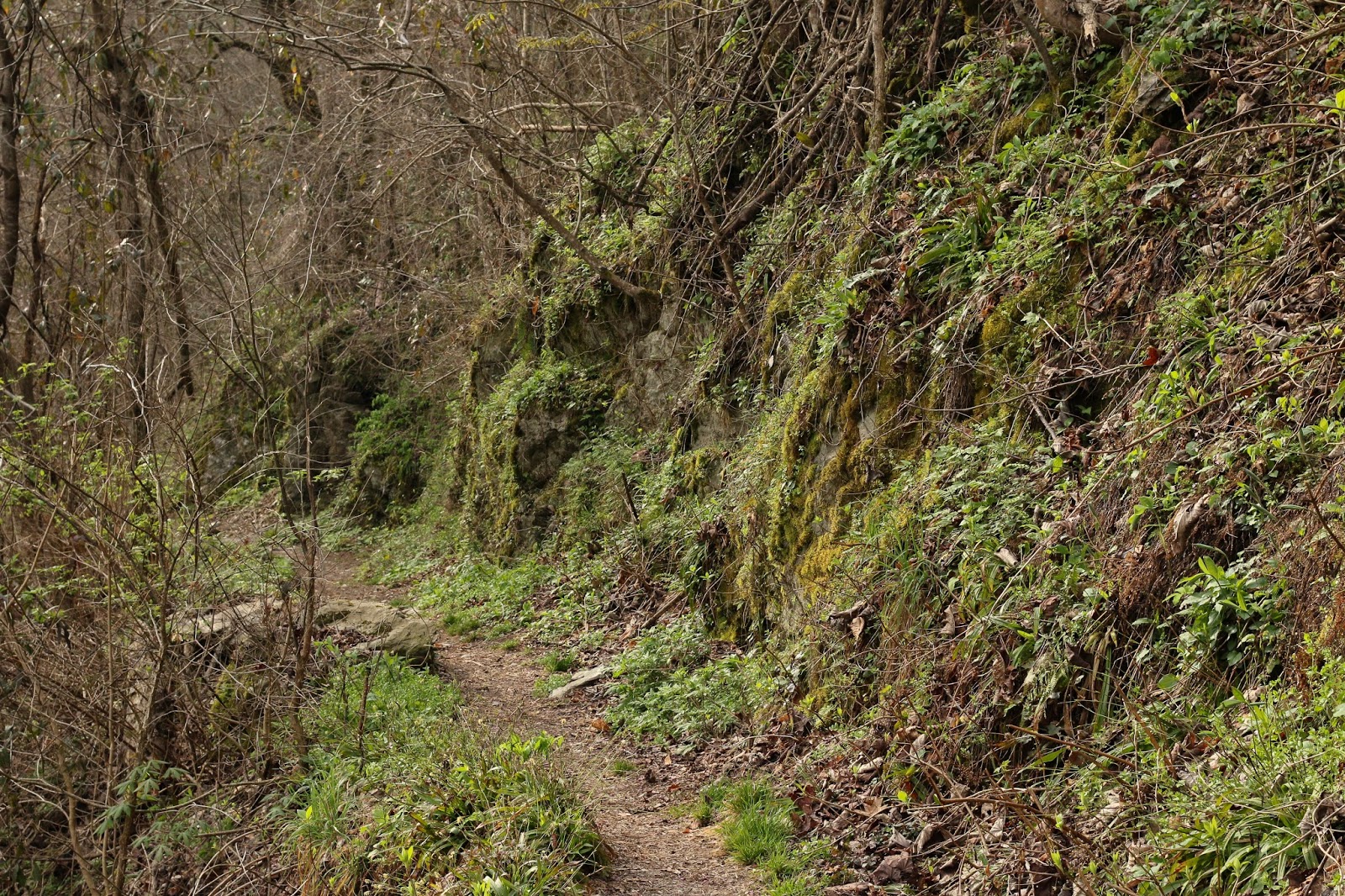
NOTE: IN ORDER TO BETTER SEE PHOTOS IN THEIR FULL 1600 PX. RESOLUTION, VIEW THEM IN THE ALBUM FORMAT BY CLICKING ON THE LEAD PHOTO OR ANY PHOTO IN THE POST. This is especially true for landscape shots. Thanks to Mark for the idea of adding this alert so the photos can be seen at their best!

Saturday, April 7, 2018

The Good and the Bad, The Bitter and the Sweet - Andrew Jackson

While passing through Tennessee on my way down to Georgia I stopped at The Hermitage, home of former U.S. President Andrew Jackson.


Admission was $20, audio tour headphones were available but I don't like blocking out the sounds of the real world so I passed.  The admission gets you access to the museum and the plantation that was his home. I didn't want to wait more than an hour in line to get in to the home, so I satisfied myself with walking the grounds and taking in the information in the museum.


Jackson was born in 1767 in South Carolina to recent immigrants from Ireland. His father died before he was born, and at the age of 13 he and his brothers joined the fighting against the British in the Revolutionary War. His brothers died during the war, one from heat stroke and the other from smallpox, and his mother died from cholera while nursing sick soldiers.  Andrew Jackson was orphaned at the age of 14.


From the Hermitage website:
After the war, Jackson briefly resided with members of his mother’s family but soon went to Charleston and embarked upon a campaign of youthful adventure and mischief.

About this time, Jackson received a modest inheritance from a grandfather still in Ireland. When his money ran out, Jackson finished school and, although he disdained studying, worked as a schoolteacher for a short period. Tall and lanky with red hair and piercing blue eyes, Jackson was known for his fiery temper, fearlessness, playful personality and daring spirit.


At the age of 17 he decided to become a lawyer and by the time he was 21 (sure took a lot less time to become a practicing lawyer in those days!) he was appointed the district prosecuting attorney in the "Western District" and that is how he came to Tennessee. When Jackson moved to Nashville he met the already married Rachel Donelson Robards. Believing her first husband had divorced her, Rachel and Andrew visited Natchez with friends and the two of them returned married in 1791.  Jackson and Rachel never had children of their own, but Jackson became the legal guardian to a number of children including a nephew they named after him and an orphaned Native American child he found in battle. The boy, Lyncoya, was sent back to the Hermitage and was educated along with Andrew Jr., and Jackson had aspirations of sending him to West Point as well. Unfortunately, political circumstances made that impossible and he instead trained as a saddle maker in Nashville. He died of tuberculosis in 1828.

School field trip kept the line long to the museum

The fact that he adopted and obviously cared deeply for a Native American child is such a contradiction to his attitude toward the removal of the Native American tribes east of the Mississippi.

Virginia bluebells

According to the Hermitage website, Jackson argued that the United States policy of attempting to assimilate the tribes into white society had failed and the Native Americans’ way of life would eventually be destroyed. Furthermore, he recognized that whites desired their lands and feared if the Native Americans remained in those areas they would eventually be exterminated. Opposition groups fought Jackson’s removal policy in Congress, but their efforts failed by a handful of votes. Congress’ authorization of the Indian Removal Act in 1831 empowered Jackson to make treaties with the tribes in arranging for their displacement.  The Indian Removal process was completed two years after Jackson left office with great loss of Native American life due to this corruption, inadequate supplies and removal by force.


That explanation sounds a little too noble to me, and I find it hard to believe his actions were to keep the Native Americans safe from extinction due to fighting over land with the white man.  I intend to do more research on the subject because of course every side has a different take on such a complex situation and the outcome after all affected my family since I have a Cherokee ancestor.  So much to know, so little time to read!  Still, current political scientists have him ranked at #15 in the list of Presidential Rankings that came out in February just one spot ahead of John F. Kennedy...and Donald Trump comes in dead last at #44.  And by the way, Obama came in at #8, up from the last survey where they placed him at #18.


Of course Jackson also owned slaves, so when I was visiting the museum all the signs touting him as the "President of the People" left a bitter taste in my mouth since he obviously didn't include anyone with skin that wasn't white as citizens.  However, for the times he was unique in his championing of what was right for the "common people" and led the way to shaping our governement toward those ideals today.  Small steps, I suppose.


When Jackson ran for office in 1828 he suffered through a mud slinging campaign that sounds familiar in light of how campaigns are run in current times.

President Adams’ supporters accused Jackson of being a military tyrant who would use the presidency as a springboard for his own Napoleonic ambitions of empire. For proof, they brought out every skeleton in Jackson’s closet; his duels and brawls, his execution of troops for desertion, his declaration of martial law in New Orleans, his friendship with Aaron Burr, and his invasions of Spanish Florida in 1814 and 1818.


The most painful attack for Jackson, by far, was that on his and Rachel’s character over their marriage. Technically, Rachel was a bigamist and Jackson her partner in it. Adams’ supporters thus judged Jackson as morally unfit to hold the nation’s highest office...They struck back with attacks on corrupt officials in Adams’ administration and labeled Adams an elitist who wanted to increase the size and power of government to benefit the aristocracy.

Fritillaria meleagris - Snake's Head Fritillary

Jackson took office with expectations to cleanse government of corruption and restore the nation’s finances. Jackson kept a watchful eye over government expenditures and congressional appropriations. In one instance, he vetoed a road bill approved by Congress. On top of being too costly, the bill only benefitted one area of the country and failed to improve the nation’s defenses. Prior to Jackson, presidents had only vetoed legislation they believed to be unconstitutional. Jackson established a new principle of vetoing legislation as a matter of policy. Jackson’s spending controls along with increased revenue enabled him to pay off the national debt in 1835 and keep the nation debt free for the remainder of his term. This is the only time in the nation’s history that the federal government was debt free.


The homeschooler in me loves that Jackson was largely self-taught. He read widely from the Bible and the classics to dozens of daily and weekly newspapers. Below are some other interesting facts.


  • First president to be a resident of a state other than Massachusetts or Virginia
  •  First Tennessee representative to the U.S. House
  •  First president to ride a train
  •  First president to be assaulted while in office
  •  First president to be the target of an assassination attempt
  •  First president born to immigrant parents
  •  Last president to serve in the Revolutionary War (he participated at age 13!)
  •  Only president to have been held as a prisoner of war
  •  Only president to raise a Native American child—Lyncoya, who was found orphaned after the Battle of Tallushatchee (1813)
  •  Only president to serve in both the American Revolution and the War of 1812
  •  Only president to pay off the national debt


Jackson survived numerous attempts on his life as a soldier, he overcame smallpox at age 14, he was shot while dueling, and even an assasination attempt while president.

From the History Channel: Richard Lawrence, an unemployed house painter, approached Jackson as he left a congressional funeral held in the House chamber of the Capitol building and shot at him, but his gun misfired. A furious 67-year-old Jackson confronted his attacker, clubbing Lawrence several times with his walking cane. During the scuffle, Lawrence managed to pull out a second loaded pistol and pulled the trigger, but it also misfired. Jackson’s aides then wrestled Lawrence away from the president, leaving Jackson unharmed but angry.


Jackson served two terms as President and lived another 8 years to the age of 78.  In 1999 researchers obtained samples of his hair from The Hermitage and had them tested.  It was reported in the Journal of the American Medical Association that the real cause of death for Andrew Jackson was lead poisoning, most likely leached out from the bullets left for decades in his body from dueling.

Amusingly, when Jackson died his pet parrot, Poll, attended his funeral service but had to be removed after he started cursing at the mourners. According to the Presidential Pet Museum Andrew Jackson wasn’t the only American president to have a bird as a pet. The long list includes:


Thursday, April 5, 2018

Just as Much Fun the Second Time Around - Little River to Cucumber Gap

Last Wednesday I ignored the sign at the entrance to Elkmont campground that said it was full, figuring there had to be a small site or two unsuitable for campers available.  They had most of the campground closed off, and half a dozen sites still available but I had to pick one fast because I wasn't the only one driving around trying to pick one out.


Once I had my tent set up (too many neighbors, fingers crossed that everyone was too tired for campfires) I got back in my car and drove up the hill to the trailhead for the Little River Trail, eager to hike it for the second time around.


The first mile of the trail runs up a gravel road past sites of past cottages that the NPS just recently finally demolished due to their dangerous condition.  When I visited in 2016 some of the cottages were still standing and I peeked in windows but there was broken glass and crumbling walls so I kept my distance for the most part.  Now all that is left is the stone foundations and fireplaces.


Four of the cabins were renovated instead of being taken down and here is a link with more information about that endeavor.


The cottages were part of the Appalachian Club and the Wonderland Club, where wealthy Knoxville residents came in the summer to beat the heat and maybe do a little fishing.


Large boulders painted with lichen crop up just past the old cottage area, with wildflowers mixing in happily with non-native neighbors.

Cymophyllus  fraseriana - Fraser's Sedge

Before it was a resort the area was sold to the park by the Little River Logging company which ceased operations in 1938, and had rolled up its tracks by early 1940. While the majority of old growth trees are gone thanks to the logging, the benefit of new growth forest is it's easier to see the undergrowth, the wildflowers and the streams.


The Yellow Trillium was especially plentiful.

Trillium luteum

The old railroad bed follows the river, reportedly home to Hellbender salamanders and even river otters though all I've seen are Blue Herons both on this visit and when I hiked this in 2016.  Click the link to see what this hike will look like in a month!


If you look closely in the center of the photo below you might see a turkey or two that was eager to avoid my prying eyes.


I found a stream to play around beside, where I discovered some trout lilies in the undergrowth.  I thought about turning over rocks to look for salamanders but the day was getting short and I wanted to make it to the Cucumber Gap intersection at least.


Trout lilies, trillium, rue anemone, even spring beauty, all the early spring wildflowers were opening up and visible alongside the trail.


In one spot under a seeping rock wall I even found one lonely Dutchman's Breeches blooming!


At the 2.2 mile point the trail crosses Huskey Branch Falls, which was roaring along nicely.


Huskey Branch Falls is 20 feet high and a wooden bridge extends right across the middle of it along the trail.  Of course I had to climb up the rocks alongside of it and look back down to the river!

Easier to climb without the backpack, it looks so small on the bridge!

And looking out from the wooden bridge is a nice view down the river.  Where are those otters?


Little River Trail is also home to the Smokies’ famous “synchronous fire flies.” In early summer, groups of male fireflies flash in unison, transforming the forest from total darkness to a spectacular light show every few seconds. Do a google search for information on this amazing sight, though you can only get in to watch by entering the lottery and taking a shuttle bus.  Maybe some June in the future we'll be in line, who knows?


I did make it to the junction with Cucumber Gap, and would have loved to go on another 1/2 mile to see the old railroad bridge, but with 2.5 miles to go back to the parking area and dusk already upon me I sadly turned around.  I highly recommend hiking just before dark sometime - I got to see the river glowing with the shine of the moon and the bats come out and circle above me.  Breaking into a jog a few times got me down to the last half mile as dark finally fell, safe on the wide paved pathway and soon snuggled up in my down sleeping bag in a surprisingly quiet campground.  No electricity at the park and a day on the trails probably contributing to folks going to bed early!


Before I sign off, I found this mystery flower scattered around the area where the buildings had been located along the trail.  It's not in my "Wildflowers of the Smokies" handbook so I'm assuming it was planted by the inhabitants.  Help identifying it would be appreciated, chime in down in the Comment section if you know what it is!


Wednesday, April 4, 2018

"A Fire That No Water Could Put Out" - MLK at the High Museum of Art

When I was driving to Georgia I heard on NPR that there was a photography exhibit to commemorate Martin Luther King Jr. at the High Museum of Art in Atlanta, so of course I had to make a detour.  The title of the exhibit was "A Fire That No Water Could Put Out", which was referring to the incident in the first week of May 1963 when Birmingham police and firemen attacked civil rights demonstrators with fire hoses, many of whom were children, in the streets bordering Kelly Ingram park.


I have a book of quotes "The Words of Martin Luther King Jr." that I bought a few years ago, and of course with the troubles we are having in our nation now with fear breeding hatred for those who are different his words are as true today as they were then.  And so on this anniversary of his death I will just let his own words and the photographs I felt most drawn to speak for themselves. 

"Justice for black people will not flow into society merely from court decisions nor from fountains of political oratory. Nor will a few token changes quell all the tempestuous yearnings of millions of disadvantaged black people.  White America must recognize that justice for black people cannot be achieved without radical changes in the structure of our society."

Grass Roots Organizer, Mississippi 1968


"An individual has not started living until he can rise above the narrow confines of his individualistic concerns to the broader concerns of all humanity." 

Baltimore, 1963

"We are prone to judge success by the index of our salaries or the size of our automobiles, rather than by the quality of our service and relationship to humanity."

MLK funeral street scene, Atlanta 1968

"There is little hope for us until we become tough-minded enough to break loose from the shackles of prejudice, half-truths, and downright ignorance."

Freedom bus riders, Ohio 1964

"We must accept finite disappointment, but we must never lose infinite hope."

Inside the State Capitol of Georgia

"There is nothing that expressed massive civil disobedience any more than the Boston Tea Party, and yet we give this to our young people and our students as a part of the great tradition of our nation.  So I think we are in good company when we break unjust laws , and I think those who are willing to do it and accept the penalty are those who are part of the saving of the nation.

Outside the State Capitol of Georgia 

"Now is the time to make real the promise of democracy and transform our pending national elegy into a creative psalm of brotherhood.  Now is the time to lift our national policy from the quicksand of racial injustice to the solid rock of human dignity."

Tuesday, April 3, 2018

Hello at Kephart Prong, Goodbye at Chestnut Top

I'll start my recap of my recent trip at the end where I stopped at Great Smoky Mountain National Park for a night and a morning.  It only added an hour to my trip home from Georgia, so I swung up through Cherokee and started over the mountain and into the park.


I've never taken the Kephart Prong Trail, every time I've driven past I didn't see the sign until I was past it.  After driving all day I figured I'd at least get out and stretch my legs before finding a campground.


Kephart Prong is a branch of the Oconaluftee River and is named for Horace Kephart whose life didn't start here but led him here:

Born in Pennsylvania and raised in Iowa, Horace Kephart enrolled in graduate school at Cornell by the age of 17. He became an expert on early western explorations, was named head of the prestigious St. Louis Mercantile Library, and was married before he was 25.

But his marriage proved unhappy. Kephart turned to heavy drinking, and when he lost his job and his wife left him, taking their six children with her, he suffered a breakdown. He decided to start over in a place where he could lose himself in the wilderness and find a new purpose for his life. 
(quote from PBS.org)


Eventually he wrote many articles that contributed to the National Park coming together.  It's a lovely stroll with a very slight incline that continues along the river.  I only went about half a mile in and turned around, I was too eager to get set up in a camping spot!


I stopped at a few overlooks to take in the views near the top, it was cloudy and gray but still beautiful.


Still too cool at higher elevations for the trees to be leafing out but lots of lichen to liven things up!


I spent the night at Elkmont and actually ended up hiking until dark but I'll post about that later.  In the morning I had to say goodbye and head home, but not before a morning hike at Chestnut Top.

"The Wall" famous for its wildflower variety

One of the most prolific displays of wildflowers in the park happens here along the first half mile of the trail, you might remember from my post when I visited it in 2014. 

Bloodroot

I was a few weeks too early for the big show, but the wildflowers have started even though it was only March.  Bloodroot, Trillium, Spring Beauty, Toothwort, Violets, Hepatica and Rue Anemone were all on display and stopping to look at them makes you forget the steep climb that is part of the beginning of the trail.

Trillium simile - Sweet White Trillium

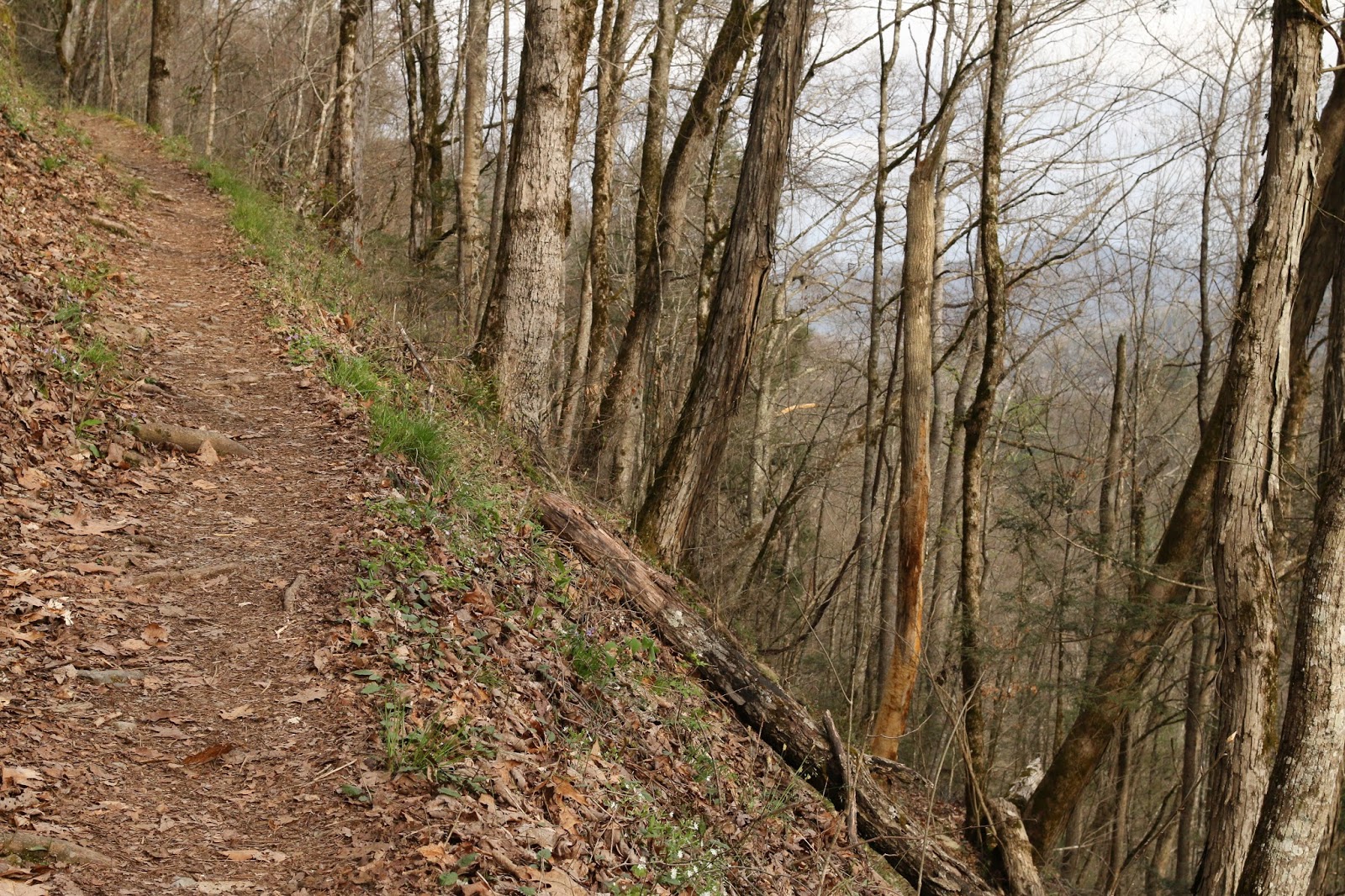
Pay attention to where you place your feet, as the climb continues the drop off beside the trail gets steeper and steeper!


Chestnut Top was named for the Chestnuts which are no longer thriving due to a fungus.  Hopefully someday they will find a way to fix this, but until then there are Rosebud, Pine, Eastern Hemlock and Oaks to keep you company along with all those flowers.

Star Chickweed - Stellaria pubera

If you don't have a wildflower expert to drag around with you I recommend picking up a copy of "Wildflowers of the Smokies" at one of the visitor centers like I did years ago when I first started coming to the park.


The trail turned and leveled out after that 1/2 mile, giving me an opportunity to rest for a few minutes and enjoy the breeze under the pines. Did I mention it was already 70F? 


Along the ridge I was able to spot many lichen varieties, and scope out the neighboring ridge and gap hoping to spot a bear foraging but no luck on this day.  Bears do frequent this area of the park, so be bear aware though you are safe as long as you keep your distance, especially from mothers with cubs.


The trail continues on 5% grade switchbacks, quite the leg trembling journey for a girl from Wisconsin.  I was passed twice on the two mile section of this 4.3 mile trail that I hiked, the second time by a 78 year old gentleman from Oklahoma who moved to nearby Maryville a year ago and hiked this trail all winter long.  Gordon was quite an inspiration and a reminder never to give up on taking care of your health and your body which will function better if used in the way it was intended instead of sitting around in front of the computer or TV.  We hit it off so well that we met for a cup of soup at Lambert's Southern Pies in Maryville!  You can find adventure and wildflowers on mountain trails, but I got to say hello and goodbye to a new friend as well!

If you missed my past hiking adventures in this favorite National Park of mine, click on the Great Smoky Mountain NP tab on the left column beside this post to check out the trails in 3 seasons!