NOTE: IN ORDER TO BETTER SEE PHOTOS IN THEIR FULL 1600 PX. RESOLUTION, VIEW THEM IN THE ALBUM FORMAT BY CLICKING ON THE LEAD PHOTO OR ANY PHOTO IN THE POST. This is especially true for landscape shots. Thanks to Mark for the idea of adding this alert so the photos can be seen at their best!

Sunday, January 8, 2017

Benton History Mural

One of our stops on our road trip last week was the town of Benton, Arkansas. I didn't realize it but there was a New Deal mural from the old Post Office located in the Saline County Courthouse there.  I missed it, but I did see a large mural on the side of a building downtown.


The mural’s story of Benton’s history begins with the 1400s when Native Americans inhabited the area and ends in 1900 when the trains were in their heyday and pottery was a thriving industry. Central to this timeline is the Saline River, which brought people to the area and was one reason why they stayed; the river is depicted in the background of the mural.


We had breakfast at Jimmy's Diner, home of the best pancakes I've ever eaten.  But the best part was when I ordered a hot water for tea and the waitress brought me hot tap water in a plastic cup instead of a pot of boiled water for tea.


But the real treat was after breakfast when we saw the cute VW Bug painted pink and sporting eyelashes!  Linking up to Monday Mural.  More Presidential stuff yet to come, lots of research involved!

Friday, January 6, 2017

The Three D's - Dubya, Downtown Dallas and Dealey Plaza

Also on our presidential tour was a stop in Dallas to see the George W. Bush Presidential Library and Museum.  I have seen 7 National Archive Presidential museums now, and unfortunately this one was hands-down the most expensive and the least impressive.


Parking was $7, and entrance to the museum is $16 for one adult. A large portion of the museum seemed to be dedicated to the "war on terror" and of course the tragedy on 09/11.  The focus was on the events and little of the president's actions seemed to come across.  While the events and the aftermath were a large part of his presidency I would have liked more detail on his specific actions since it was a presidential museum and not a war memorial.

Steel from the World Trade Center

President Bush’s words from his national address given from the Oval Office that evening: “Terrorist attacks can shake the foundations of our biggest buildings, but they cannot touch the foundation of America. These acts shattered steel, but they cannot dent the steel of American resolve.”


A reminder about "No Child Left Behind" wasn't something either of us were particularly fond of  considering how it has transformed the classroom into a standardized testing factory in an effort to hold schools to certain performance standards.  Ugh.  For example, the grade school Katrina attended in 3rd grade taught them the test for a month for almost the whole day, neglecting any learning that might have actually been enriching.  When time came for the test their teacher walked around the room and "helped" them with tough questions.  Another teacher told me that at the end of the day that same helpful teacher was locked in her classroom with all the test booklets for hours.  Katrina was a nervous wreck for those weeks, and had nightmares on how she would perform due to the pressure that was put on them to do well.  We left public school for homeschooling not long afterward, and thankfully Wisconsin was a state that did not require standardized testing for homeschooled students.  Katrina now has a Master's Degree so I think she did okay getting into college and pursuing her education, all without standardized testing until she took the ACT.

Katrina took Sociology of Education at UW Eau Claire where she learned that while the legislation was well intentioned it has fallen short of what it set out to do.  Here's a bit of good news, in December 2015 Congress passed the Every Student Succeeds Act to replace NCLB. ESSA moved in the opposite direction—it seeks to pare back the federal role in K-12 education and will go in effect for the 2017-2018 school year.  Education is one area I think we have a long way to go as a nation, Katrina tells me that a study that polled high school exchange students revealed that they have less homework and more vigorous material during the day which was an observation I made when we were homeschooling that much time seems wasted during the day only to send busy work home and take time away from family and much needed leisure time for children.


Whew!  I didn't mean to go on at such length!  Another exhibit talked about Hurricane Katrina, which was not a high point of the Bush administration.  From Wikipedia: Within days of Katrina's August 29, 2005 landfall, public debate arose about the local, state and federal governments' role in the preparations for and response to the storm. Criticism was prompted largely by televised images of visibly shaken and frustrated political leaders, and of residents who remained in New Orleans without water, food or shelter, and the deaths of several citizens by thirst, exhaustion, and violence days after the storm itself had passed. The treatment of people who had evacuated to registered facilities such as the Superdome was also criticized.  Worse, apparently Bush did not mention hurricane recovery or administration involvement/shortcomings in his 2006 or 2007 State of the Union addresses.  Want to know more about how New Orleans is faring a decade after the storm, read about it in this New York Times piece.


We did enjoy the Oval Office replica and a nice employee took our picture sitting in front of the fireplace.  At the Clinton museum you were not allowed to bring your own camera into the room at all, but we did shell out the money for the behind the desk shot when we visited that one.  A nearby exhibit dealt with the family and the pets, which we have seen at each museum, and an interactive exhibit called Decision Points Theater gives the opportunity to express how YOU would act in response to major crises which we skipped.  Again, I would have liked to see more detail about Bush's actions like the bills and executive orders he signed but little was displayed in that regard.


One of the themes that keeps coming up at every presidential museum is their efforts on behalf of immigration.  This is a topic that touches me deeply and I plan a separate post on the history of immigration legislation.  We've also been keenly aware of how no matter which president or how many years it has been, certain "problems" seem to recur in our government and our society.  Do we learn from history?  I hope so.

View of Dealey Plaza not far from spot where Zapruder film was shot

Our other presidential related stop while in Dallas was at the Sixth Floor Museum across from Dealey Plaza.  Again, we paid for parking and $16 each to get in to the museum.  If you need more in depth information about the dark events in Dallas in 1963 this could be a worthwhile stop.  It was interesting seeing where the famed assassination took place and getting a feel for the space, imagining the streets filled with 250,000 citizens who came out to see their president.

The former School Book Depository building,
now the Sixth Floor Museum 

The museum is a self-guided audio tour of billboard type displays and a look at the area where Oswald was allegedly situated when he shot JFK.  For us none of the information was new and the audio tour was annoying and turned off within minutes while we wandered around scanning the boards.  The only items of interest for us were as I said the view out the window and also a miniaturized model of the plaza and where the automobiles were placed at the time of the shooting.  For me it seemed to raise more questions than it answered as it seemed the window in question was an unlikely spot considering he would have had a much better shot while the cars were coming toward him than after they had turned the corner and were moving away.  But who knows what happened?  Maybe he had a malfunction with his gun and was delayed in his shot?  


The only pieces of information relating to the investigation that were new to me was that President Kennedy had 400 death threats in the 9 months prior to his trip to Dallas and new information regarding the sound tests performed on the Dictabelt recording from a police officer's motorcycle that was part of the motorcade.  For those results follow this link.


We walked around downtown Dallas while waiting our turn to get into the museum, noting many references to Pegasus.  Apparently it was the symbol of Magnolia Oil which was later folded into Mobil Oil and has a long history in Dallas.

Unique Christmas tree in Pegasus Plaza

I'm sure we missed a lot, but you can't do it all in one day, right?  We did get to try Hypnotic Donuts in one of the local coffee shops and took a quick walk through Neiman Marcus where we were unsure whether or not to be impressed by a Dyson hair dryer.  If you're in the market for a $399 hair dryer you can also get one at Ulta!

We are missing those warm Texas days already, tomorrow we will be home, and tonight we are hiding in our hotel from the  -1F wind chill here in Indiana!

Monday, January 2, 2017

Herbert Hoover - The Good Neighbor

Our visit to the National Archives Herbert Hoover museum in Iowa was our first stop on this trip where we were eager to learn more about our 31st president.  There was a Christmas tree exhibit featuring toy themes that was especially fun.  I like the rock 'em sock 'em robot topped tree best.


The toys on that tree reflected the childhood of my youth, but Hoover's childhood was of a different era.  Born in 1874 he lived in the small town of West Branch, Iowa for the first nine years of his life. His Quaker father, Jessie Clark Hoover, a blacksmith and farm equipment salesman, suffered a heart attack and died when Herbert was six years old. Three years later his mother, Huldah Minthorn Hoover who was a seamstress and recorded Quaker minister, developed pneumonia and also passed away.  This left Herbert, his older brother Theodore, and little sister Mary orphaned and passed around among relatives for a few years, Hoover ended up with his uncle, Dr. John Minthorn, who lived in Oregon. I wonder what kind of toys he played with, if any?  Most likely there was little time for play but I'm going to assume his agile mind found time for books!  He went from being an orphan to becoming a wealthy engineer; his work during World War I led to his being appointed Secretary of Commerce, and he served under both President Harding and President Coolidge.  On the other hand, his two children were born in London to successful parents so they probably had all the latest toys of the day!


(Bear with me here and read this long paragraph through to the end, there is some good meat in it, not just dry facts!)

Herbert wanted to be a mining engineer, and it was at Stanford that he met his wife, Lou Henry.  
Hoover graduated in 1895 over the next two decades he made his fortune as an international mining engineer and financier.  By 1914, however, he yearned for more than wealth and World War I provided him with an opportunity for public service. He aided Americans stranded in Europe when World War I broke out by setting up an emergency center and canteen at the Hotel Savoy with 500 volunteers who helped citizens as diverse as Chief White Feather of Pawhuska, Oklahoma. Together with other engineering friends they loaned 1.5 million dollars to stranded travelers to get them home.  Later, he established the Commission for Relief in Belgium to provide food for the civilians trapped in the war zone, putting his career on hold and accepting no salary for the work.  He crossed the North Sea 40 times to persuade the enemies in London and Berlin to permit food to pass through.  He convinced the Belgians that cornmeal was more than cattlefeed and the organization saved 10 million people from starvation.  

Why are we not nominating more Americans like this for public office?  WHY??  Katrina says it's because corporations pay to bankroll candidates through their election funds due to Citizens United and PACs and it is this money that is highly influencing what candidates make it to the big stage due to what they can do for the corporations.  What humanitarians turned politicians are we missing out on due to these policies?

While President-Elect Hoover visited eleven South American countries before his inauguration!

Hoover's wife Lou was a fine horsewoman who also hunted and preserved specimens with the skill of a taxidermist. She developed an enthusiasm for rocks, minerals, and mining, and that led her to become the first female geology major at Stanford.  Herbert graduated before she did and went to work in the gold fields in Australia but as soon as she was done with school they married.  She is incredibly interesting in her own right, traveling around the world with her husband and they were even present during the Boxer Rebellion.  They both learned to speak Chinese and to this day she is the only First Lady to learn an Asian language, not to mention the fact that she spoke 8 languages!

Katrina admires a past Girl Scout promoter

This woman is my new hero, right?  On top of all that she spent many years of her life involved with the Girl Scouts movement, and we were delighted to find an exhibit reflecting that great public service of hers.  She served two terms as the president of the organization the first time while her husband was serving under Presidents Harding and Coolidge and the second time after her husband left the presidency.  Her love of the outdoors continued throughout her lifetime and she was also an avid amateur photographer and had a home movie camera.

There is much to know about this lady, for more on Lou Henry Hoover go to this link.


Here are some of the domestic accomplishments of President Hoover during his presidency:

  • Presided over the 1929 Wall Street Crash and the Great Depression and initiated government economic recovery programs in the spirit of public-private partnerships that met with limited success
  • Promoted public works efforts such as the Hoover Dam
  • Appointed the conservationist Horace Albright to the National Park Service and placed nearly two million acres of federal land in the national forest reserve, demonstrating his belief in the conservation of national resources.
  • Increased tariffs with the Smoot-Hawley Tariff Act in order to encourage the purchase of American-made goods. (Instead, the Act resulted in contracted international trade and a worsening of the Great Depression)
  • Raised taxes by increasing the top tax bracket from 25% to 63% and increasing corporate taxes
  • Supported the Glass-Steagall Act limiting commercial bank securities activities
  • Advocated strong labor regulation laws, including the enactment of the Bacon-Davis Act requiring a maximum eight-hour day on construction of public buildings and the payment of at least the "prevailing wage" in the locality
  • Expanded civil service coverage of Federal positions
  • Canceled private oil leases on government lands
  • Instructed the Justice Department and the Internal Revenue Service to pursue gangsters for tax evasion
  • Signed the Norris La Guardia Act to limit judicial intervention in labor disputes
  • Dispersed the "Bonus Army" of WWI veterans who marched on Washington to demand bonus payments in 1932
  • Required air mail carriers to adopt stricter safety measures and improve service
  • In 1929 got Congress to pass the Agricultural Marketing Act, replete with a Federal Farm Board but with no subsidies for farmers like he originally wanted.

For an in depth look at the foreign policy accomplishments of President Hoover see this link.


Hoover was not surprised at the Stock Market crash which precipitated the Depression. Though his concerns and suggestions went unheeded before the crisis his administration worked hard to stimulate the economy.  Unfortunately the Great Depression was more than an economic downturn and all efforts to bounce back met with failure.  It was this, along with the demands of the Bonus Army that led to his declining popularity and led to his defeat when he ran against Franklin D. Roosevelt for re-election.

In the post-World War II years, Hoover remained committed to public service and to commenting on both domestic and international affairs. For the Truman administration, Hoover served as coordinator of the Food Supply for World Famine in 1946 and advised the U.S. government on occupation policies in Germany and Austria. In 1947, a Republican-led Congress named Hoover chairman of the Commission on the Organization of the Executive Branch of Government, which became known as the "Hoover Commission."

We learned A LOT at this museum!  I left feeling like I understood how the events of that time worked together and highly recommend a trip to experience it for yourself.

Friday, December 30, 2016

Truman's Independence

So Katrina and I have hit the road for our big Presidential Tour.  First stop was the Herbert Hoover Museum in Iowa, but I'm going to share today's adventure in Independence, Missouri first.


Independence is President Harry Truman's hometown and it had a beautiful courthouse which gives guided tours.  Our guide was wonderful and I won't spoil it by giving it all away.  It's less about the architectural aspects and more about Truman who was responsible for its expansion/reconstruction when he was an elected judge in Jackson County before his career in the Senate began.

Device Truman used to sign multiple documents at once!

Also in the museum is art by George Caleb Bingham, who was a self taught artist of the newly expanding west.  A lot of his work depicted commerce and daily life, including this engraving titled "County Election" with an amusing collection of voters waiting in line.


On the town square was a covered wagon giving a history tour puled by horses wearing Santa hats.  Those poor horses!  At least it was a sunny day.


Independence is also known as a mecca for the Church of Latter Day Saints, and a Visitors Center is located there to guide those looking for Mormon attractions in the area.  We didn't go inside, but admired the architecture of a church site across the street.  Here is a list of sites if you're interested.


But the main reason for our visit was of course the National Archives museum for President Truman.


Katrina checked out the gift shop first, getting very excited when she found a Rosie the Riveteer rubber ducky to take home with her.


But of course what drew my eye upon entering was the mural "Independence and the Opening of the West" painted by Thomas Hart Benton.  Native Americans from the Pawnee and Cheyenne tribes are depicted, as well as Fort Bent along the Santa Fe trail on the Arkansas River.


When Truman himself came to check on the progress of the mural the artist invited him to come on up the scaffold and paint a few strokes of the blue sky.


If you're not familiar with Truman as president, his is an interesting story.  He was Vice President and became president when Franklin D. Roosevelt died suddenly of a stroke in the last months of World War II.  He instantly inherited a lot of serious problems.  Not only did he have to contend with the defeat of the Germans, for months the war with Japan still dragged on, and the atomic bomb was seen as a solution to ending the war quickly.


After the war he had the job of trying to rebuild our economy.  He wanted to gradually remove wartime wage and price controls to avoid shortages and inflation.  He was a true liberal who wanted to ban racial discrimination in employment, expand social security benefits, raise the minimum wage by 50% percent and clear slums and build housing.  This proved to be too ambitious for Congress who blocked most of the reforms and unfortunately inflation, shortages and strikes resulted.  Even though he had given solutions that were ignored to prevent the situation he and his party were blamed. He also wanted to enact government sponsored health care like Great Britain did.  Think how long we have been trying to get that off the ground!  He did see some success in that area when Medicare and Medicaid were enacted, and President Lyndon B. Johnson signed them into law in the museum with Truman in attendance. A look at the list below will show most the issues of his presidency are not different from those we are still battling over more than half a century later including voter rights laws and higher taxes on the wealthy.


It wasn't just the end of WWII and the recovery of our economy on his plate, here are some quick bullet points:
  •  President  Truman signed the United Nations Charter and the United States became the first nation to complete the ratification process and join the new international organization.  
  • He undertook extensive renovation of the White House due to structural problems
  • Was the first to recognize the new nation of Israel
  • Appointed justices to the Supreme Court who believed in Civil Rights 
  • Dealt with the emergence of Soviet/Cold War tensions post World War II
  • Dispatched troops to South Korea to try to contain the spread of Communism


He had a LOT of hard decisions to make, as most U.S. Presidents do.  Not all of them were popular, as is true today.


Thursday, December 29, 2016

2016 Year in Review - the Second Half

At the end of our time in North Carolina in May I split off from Wayne and Cory and headed to Pilot Mountain State Park for a hike through the mountain laurel.

Pilot Mountain

Then I met up with them again at Carter Caves State Park in Kentucky.  With all the caves there are in Kentucky I usually pass them by, but this time Cory and I took the cave tour.  The guys passed when I pleaded for a trail partner, so I had to enjoy the great hiking trails and natural rock formations by myself.

Fern Bridge at Carter Caves State Park

Back in the Midwest for the summer I hit a variety of state parks and sections of the Ice Age Trail.  From Pike Lake and Long Lake in Wisconsin on up to West Bend, Hartman Creek and then further north to Council Grounds State Park where I finally hiked the Grandfather Falls segment of the IAT.


Toward the end of July we experienced a heat wave so north I went again, this time up to Munising in the Upper Peninsula of Michigan which has become a favorite of mine despite having to worry about encountering mosquitoes and biting flies.  I stayed at Bay Furnace campground where I got to attend a ranger program on owls, and discovered a lovely little hydroelectric station at Au Train Falls away from the main tourist area.


I helped Katrina out at on National Night Out with her Girl Scout recruitment efforts...


And experimented with shooting family portraits for a friend.


Come August it was time for another big road trip with Wayne and Cory, but this time we stopped and bought a new toy hauler along the way!


Then we were westward bound to Colorado's Rocky Mountain National Park!

Wayne on the Fern Lake Trail

Overall there are national parks we've enjoyed more but we had a good time.  Estes Park is a great little town, but RV parks are overcrowded and overpriced.  Sites within the park are nicer and roomier but come with absolutely no facilities or Verizon signal or wifi.  If we came again I would opt to stay in the park, but we did get some wildlife sightings at the RV park in town before we gave up and left a day early.

Deer behind our campsite

View from one of the trails on an early morning solo hike


On our way home we stopped at Scotts Bluff in Nebraska where we had a roomier site at the city run campground for half the price.

Scotts Bluff

As August turned in to September we arrived in South Dakota where we saw tons of wildlife which included the usual herds of bison and a family of mountain goats at Mt. Rushmore...


And while in South Dakota I met up with with Linda for the first time!  She shared one her favorite hikes to Harney Peak with me, and it was worth the climb.

blogger meet-up!

Besides the awesome views I particularly enjoyed the prayer flags on the summit of what is now called Black Elk Peak instead of Harney Peak.


Wayne and Cory were doing some fishing near our campground in Custer State Park after taking our kittens for long walks in the pine woods.


All too soon it was time to move along, with one last stop in South Dakota at the Badlands National Park.

Bison in the Badlands

While other folks go to Wall for the shops, I go for those Bighorn sheep sightings!


Back home I was feeding my new Pokemon Go addiction that Cory saddled me with during our trip by taking trips down to Southport Marina in Kenosha.


Or wandering around Milwaukee finding new things to see like Black Cat Alley.


Fall comes quickly and the monarchs started their migration while the fields turned gold.


A quick side trip down to St Louis to pick up Cory's friend brought me back to some sights Wayne and I saw many years ago on an anniversary trip.


Come October Cory and I boarded a plane for Newfoundland where we reconnected with family members we hadn't seen in awhile.


And I reconnected with our family's past by exploring our "homeplace" in Argentia.


Wayne's family's homeplace in Placentia, Newfoundland is looking a little different with the opening of the new life bridge finally completed.


And while our main reason for the trip was to attend a wedding we had plenty of time for other things like hanging out with sheep, picking berries and riding the quad down on the beach rocks.


As we headed back to St.John's I took the long way and stopped in beautiful Bay Roberts, a place I can't wait to return to for some more meandering on the cliffs.


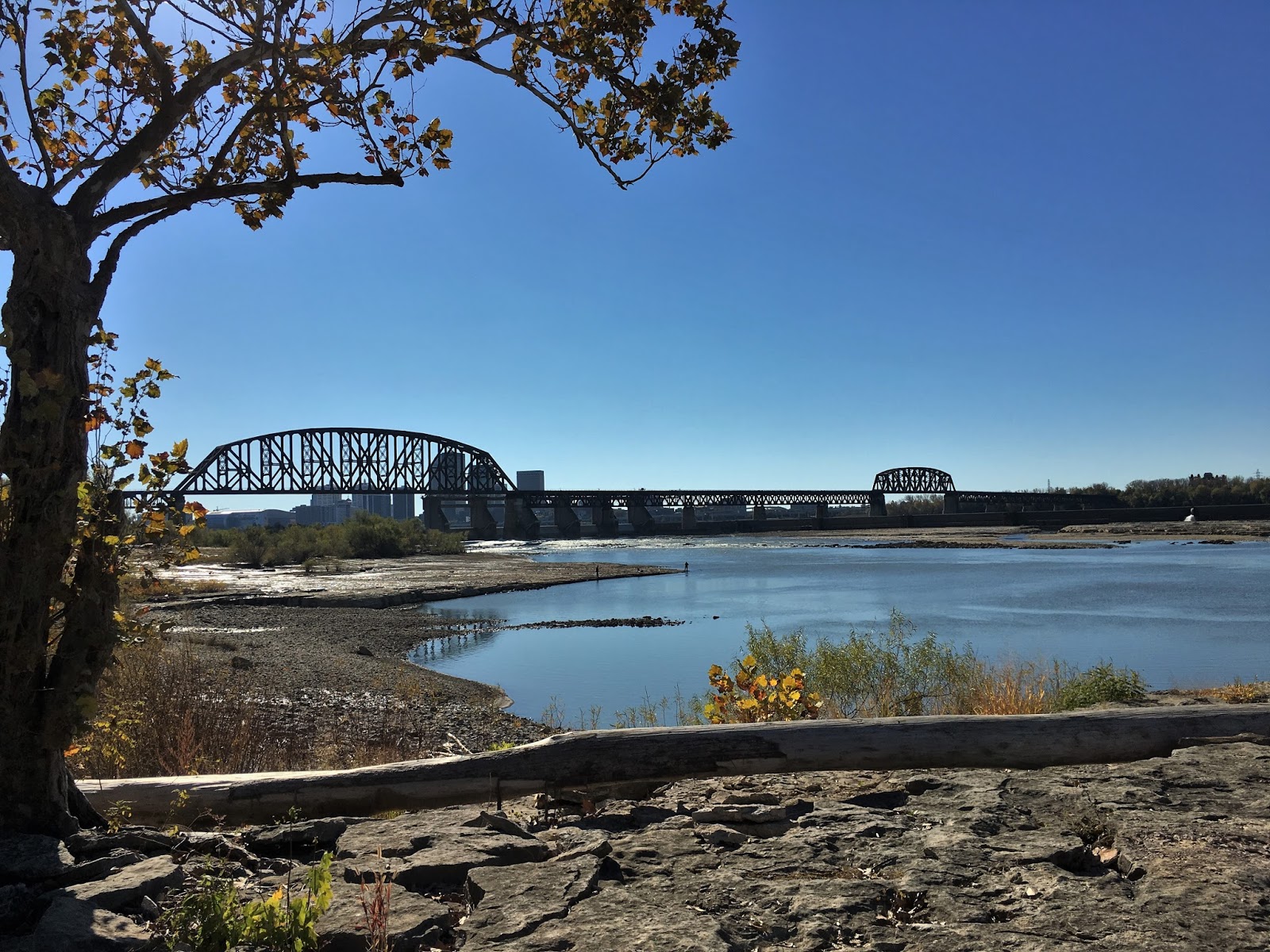
Apparently I just can't get enough of Kentucky because in November I jaunted down again, this time trying out Taylorsville Lake State Park, walking in downtown Shelbyville, and then making my way back over the Ohio River to Indiana where I finally visited lovely Falls of the Ohio State Park and scoped out the fossil beds.


Why did I stuff yet another last minute trip into a busy fall?  Because I was scheduled to get carpal tunnel surgery on both hands and knew I wouldn't be going anywhere until at least January!


First the right wrist and then the left and both are healing nicely.  Whew!  I was a lot busier scurrying around the country than I thought I was this past year.  Hope you got to do all the things you wanted to do too!